Doi Chiang Dao National Park, in
Chiang Mai province, is Thailand's third highest mountain
at 2220 metres and, viewed from Chiang Dao village, is one
of the most spectacular sights in the whole country.
Doi
Chiang Dao from nearby paddies (Photo by Nick
Upton)
This limestone massif has a number of peaks and ridges over
two thousand metres in a horseshoe shape and has a series
of forest types that change with altitude. The variety
of forest types and altitude of the mountain combined with
its close proximity to Myanmar result in a large number of
exciting birds found here as well as some excellent views
and a relaxing atmosphere. Doi Chiang Dao is certainly the
most spectacular mountain in Thailand when seen from a distance.
There is a good range of intact forests from the lower slopes
of the mountain of Doi Chiang Dao to the high summit. Forest
types here include dry dipterocarp woodlands in the lower
areas, to moist evergreen forest and areas of pine woodland
with mixed deciduous areas higher up.
Although there is a small hilltribe population in one corner
of the park most of this area is too steep for it to come
under much threat. However, peridically there have been potentially
damaging projects proposed by the authorities that have included
a cable car and several road projects.
A short stay at Chiang Dao can suit both birders and non-birders
as the views, temples and local cuisine are of interest to
non-biders while good habitat is easily accessible to birders.
Two species are the main target birds for most birders here:
Giant Nuthatch and Hume's Pheasant. Although both of these
species are now more accessible at Doi
Lang birders are likely to find themselves alone here
rather than at the more heavily-visited Doi Lang. Both of
these birds occur around the higher areas of the National
Park, generally within pine forest, where they have been regularly
seen.
Another highly sought-after bird which seems to be fairly
regularly encountered at the higher altitudes is Scaly Thrush.
Personal experience suggests that it may be the case that
some of these sightings might actually be female Chestnut-bellied
Rock Thrushes (which is a fairly common bird here) for this
species to which it bears a passing resemblance, especially
if not seen well.
Grey-headed Parrotbill, Crested Finchbill, various thrushes
and Black-tailed Crake are other memorable birds that have
been seen higher up the mountain on numerous ocassions.
The lower levels of Doi Chiang Dao offer the opportunity
to see a different set of forest birds and some open country
species. In the "spring" months Streaked Wren Babbler
is easily spotted near the temple, around the limestone outcrops.
Don't confuse this with the similar looking calcicola
subspecies of Limestone Wren Babbler which is only found in
the region of Saraburi province.
In the gullies and damp patches around the base of the Chiang
Dao massif, secretive species such as Slaty-bellied Tesia,
Scaly-breasted Partridge, White-crowned Forktail, Hooded Pitta
and Rusty-naped Pitta can be discovered with patience. Many
of the very few records of Grey-bellied Tesia have been made
around these lower, rocky slopes too.
If birders spend time at the top of the mountain, around the
lower elevations and visit some of the farmland areas, then
a very high number of species are linly to be seen.
Use the interactive map below to plan your route to
Chiang Dao Wildlife Sanctuary. The blue line shows the route
from Thapae Gate, Chiang Mai (Blue Pin, "A") to
Den Ya Kat (Red Pin, "B") and Wat Tham Pha Plong
(C).
By Car/Motocycle
This is by far the easiest way to visit this area with plenty
of vehicle hire companies in Chiang Mai at affordable prices.
Just take route 107 north, turning left onto the by-pass just
before Chiang Dao town and then turning left again towards
Wat Tham Ph Plong before which accommodations are situated.
Some vehicle rental companies have Toyota pick ups for hire
which are capable of driving up to Den Ya Kat in the dry season.
The journey from Chiang Mai to Chiang Dao passes through some
meandering roads where cars struggle to overtake and there
are frequent accidents involving motorcycles; unless one is
an experienced motorcycle driver I would not advise using
this mode of transport in Thailand.
By Bus
Getting to Doi Chiang Dao is fairly easy. If travelling by
bus from Bangkok then one must go to the Mor Chit terminal,
from where there are lots of buses every day to Chiang Mai.
From Chiang Mai take a bus from the Chang Puek (Albino elephant)
bus station to TaTorn; these leave about once every hour.
Tell the conductor that you will get off at Chiang Dao and
he will tell you when to get off: the journey takes about
2.5 hours. In Chiang Dao walk northwards along the road to
the junction for Chiang Dao cave which is signposted in English
and wait for a motorcycle taxi. Sometimes one has to wait
for 15-20 minutes for the motorcycle but I do not suggest
walking as it is about 5 Kms; not that far, but in the heat
it is a long way. When a motorcycle taxi turns up simply tell
the driver Malee's or Chiang Dao Nest, whichever you have
chosen, and the driver will take you there.
If coming from the north it is a simple affair to catch the
same bus from TaTorn to Chiang Mai getting off at Chiang Dao.
The bus terminal in TaTorn is on the south side of the river.
The journey from TaTorn to Chiang Dao takes about 3 hours.
By Taxi
There are few proper taxis in Chiang Mai but certainly from
the airport a taxi can be procured, the best way to do this
is to go to the public taxi area, just outside of domestic
arrivals, and tell the staff where you want to go and they
will tell you the price. However, these days the best way
of sorting out a taxi is using on of the ride-hailing apps;
Grab
or Bolt
are the ones to download and both are easy to use. If you
arrive at your accommodation by taxi then they will be able
to arrange a ride for you to your next destination or just
use one of the ride-hailing apps for your onward journey.
By Tuk Tuk or Motorcycle Taxi
Tuk tuks are fun to use for short journeys around town but
not for long journeys like this and they are also actually
rather expensive to use. Far better to use a taxi. Using a
motorcycle taxi from Chiang Mai would be very foolish; a long
journey on the back of a motorbike through some dangerous
traffic and roads. Think about your safety and use a taxi
or hire a car.
By Train
Chiang Mai has a teminus station which is connected to Bangkok
and various other provincial towns. The State
Railways of Thailand website has all the details. From
Chiang Mai a hire vehicle, bus or taxi wil be the way to reach
Chiang Dao. The train is very slow.
By Plane
Chiang Mai International Airport has large numbers of flights
from destinations all over Thailand and some interantional
destinations, most notably Hong Kong, Seoul, Singapore, Abu
Dhabi, Shanghai and Beijing. Once in Chiang Mai vehicle hire,
taxi or bus is the best onward option.
Visiting Den Ya Kat
Whilst staying at Doi Chiang Dao most birders want to take
a trip to Den Ya Kat near the summit for the high altitude
birds and this can be tricky. First one must get a permit
to drive to DYK at park headquarters near Malee's; this is
a simple affair. Then drive back to Chiang Dao (where there
is a petrol station) and turn south towards Chiang Mai. After
precisely 4.9 Kms there is a sign which says "checkpoint
20 Km" which has replaced the former green-roofed bus
shelter landmark that is quoted in old trip reports. A series
of roads on the right all go towards the dirt track that heads
up the mountain and one must simply twist and turn through
the maze of roads until they funnel into one. Once this turns
into a dirt track the quality deteriorates rapidly. If there
has been wet weather the track is very hazardous and a 4-wheel
drive vehicle is a must. In the dry season a regular vehicle
may be sufficient - maybe not: click
here for details of a trip here in 2002.
Bird
Watching Trips:
If you need help organizing a bird watching trip to Thailand,
take a look at the suggested itineraries for ideas on
creating a tailor-made trip and contact me for advice:
Thailand
bird tours.
Finding Birds
There rarely seems to be a shortage of birds at Doi Chiang
Dao and with two roads to high altitude there are plenty of
opportunities to find them. The higher altitudes are where
winter specialities such as Thrushes occur as well as resident
Giant Nuthatch and Hume's Pheasant.
The lower altitudes play host to large numbers of common forest
birds and the gulleys play host to exciting birds such as
Rusty-naped Pitta, Hooded Pitta and Tesias. In April and May
Streaked Wren Babbler is particularly common at Wat Tam Pa
Plong.
A number of trails are well-known for certain species;
Malee's
and Chiang Dao Nest : There are many open-country
birds to be found in the farmland around these two resorts.
Crested Treeswift is a common sight, soaring overhead and
a number of different Barbets can be found calling from the
many large trees here. It is worth scanning through the grassy
areas for Yellow-eyed Babbler, Asian Stubtail and Yellow-streaked
Warbler, all of which are rather infrequently recorded in
Thailand but regularly sighted here.
Nature Trail
: This trail goes through a lot of bamboo
forest and commences at Chiang Dao cave. Although not one
of the best trails at Chiang Dao it does provide an opportunity
to get within a territory regularly held by Oriental Hobby.
Temple Gulley
:This is one of the most anticipated trails
at Chiang Dao. In reality it is very narrow with thick vegetation
and it is difficult to get good views of birds here. There
are, however, a few places where views become unobstructed
so the best policy is to wait at these until birds come along.
There are undoubtedly a number of great birds that are often
seen along here; Hooded and Rusty-naped Pittas occur but are
tricky to see. Slaty-bellied Tesia is sometimes found here,
but White-crowned Forktail, Siberian Blue Robin, White-throated
Fantail and Streaked Wren Babbler are far easier to find.
One has to clamber along the creek bed to negotiate this trail
so it is well worth having a decent pair of boots to ensure
against slipping on wet rocks. The trail supposedly continues
beyond the water tanks which seem to be the trail's end, but
I would not suggest this to any but the most athletic birders!
Firebreak
Trail : This firebreak around the temple
grounds provides an opportunity to get into the forest but
is not the easiest to negotiate. I would not recommend it
at all after rain as it would be very slippery. Rusty-naped
Pitta is apparently a regular along here and Hodgson's Frogmouth
has been heard.
Wat
Tam Pa Plong: The easily accessed car
park and steps to the temple are a great place to get to grips
with all of the more common birds to be found here. There
are some fruiting trees at the furthest point into the temple
where lots of Drongos, Orioles, Bluebirds and Green Pigeons
feed. The limestone around the monk's quarters are often a
good place to see Streaked Wren Babbler and Speckled Piculet
can often be located from its noisy drumming. Spending time
in the temple grounds is a good way to see a high number of
bird species in a short space of time.
Checkpoint
Gulley : This gulley is accessible by
a trail which begins a short distance beyond the checkpoint
on the Muang Kong road. The vegetation is more open than at
temple gulley so that birds are more easily seen. The species
occurring here are similar to those at the temple gulley and
it is here that most sightings of Tesias occur, including
Grey-bellied as well as Slaty-bellied Tesia.
Road
to Muang Kong: This road is an excellent
location for birding and rises to a considerable altitude
giving an opportunity to see some of the birds that do not
occur lower down the mountain. Birds such as Long-tailed Minivet,
Orange-bellied Leafbird and White-browed Shrike Babbler are
commonplace higher up and other treats that I have seen along
this road are Oriental Hobby, Pin-tailed Pigeon and Hodgson's
Hawk Cuckoo. There is a summit trail from one of the highest
points along this road and although the top is still a long
way from the start this trail should offer some good birding
opportunities.
Firebreak
Trail (DYK) :About
1 kilometre before arriving at Den Ya Kat substation there
is a sharp turn to the right and here there is a nice trail
up a ridge along a firebreak. This trail is straight ahead
as one drives towards the sharp right hand turn. There are
many pine trees up here and there have been numerous sightings
of Hume's Pheasant early in the morning as it crosses the
firebreak. Other birds along this trail are Chestnut-bellied
Rock Thrush, Grey Treepie, Eurasian Jay and Rufous-gorgetted
Flycatcher which seems unusually common here.
Summit
Trail : This
trail starts to the left of the substation, going through
some grassland and then along some ridges. Quite a number
of good birds can be seen along here, including Stripe-breasted
Woodpecker, Hume's Pheasant and, of course, Giant Nuthatch
which is reliably seen at the point marked, but naturally
should be looked for all along this trail. In the grass quite
a number of Bush Warblers skulk, but I've never seen any long
enough to identify them; perhaps with the aid of a tape they
could be lured out into the open. A small pond at the substation
is reputed to be the home of Black-tailed Crake but it would
be vital to spend the night here in order to see it, but plenty
of other birds including Thrushes and Parrotbills can be seen
on a day trip.
Birding
Road : Once
past the checkpoint the access road becomes a birding location
in itself. Giant Nuthatch is often seen along here and Hume's
Pheasant is sometimes seen running across the road - try not
to run it over! There are plenty of places to stop the car
and lots of good habitat where anything could turn up.
Rice paddies:
Not so far away, east of Chiang Dao town, is an area of rice
fields that provide birders with a completely different set
of species than is found upon the mountian. Information is
located here: Chiang
Dao rice paddies.
Facilities
For a long time now birders have stayed at Malee's
Nature Lovers Bungalows a few kilometres beyond
Chiang Dao cave. Malee's set-up is quaint, with some excellent
views of the mountains; indeed, many people have been content
to spend a day birding from the garden, with some excellent
species having been recorded. There are several quite simple
bungalows to rent here, set in a very attractive garden, and
it is probably the cheapest places in the area to stay which
is also reflected in the quality.
Malee's Nature Lovers
Bungalows
Malee's is very close to forest at Wat Tham Pha Plong making
it an ideal location for going out at night to look for nocturnal
species. Packed breakfasts and lunch are also available for
those wishing to get out early and stay out all day, particularly
if travelling to Den Ya Kat. Malee can arrange for a four-wheel
drive vehicle and driver up to Den Ya Kat, something I would
recommend if the weather has been wet as the road up Doi Chiang
Dao can be a treacherous mudslide.
For those without their own transport Malee can arrange for
pickup from Chiang Mai and the airport; a very convenient
alternative to public transport! A bird log was started at
Malee's some years ago and it continues to be a good source
of information. Malee has high speed internet available, so
please send me your notable observations.
Close by is Chiang
Dao Hut which is a nice alternative where they are also
used to dealing with birders and their needs.
At Chiang Dao cave there are a number of restaurants that
sell good food for low prices.
For those that wish to camp at Den Ya Kat there are very few
facilities, just a lawn for your tent and toilets, so take
everything you need with you, although for those who smile
and look desperate enough the guards might sort out some alternative
accommodation and food, but don't count on it. For the really
adventurous it is possible to arrange porters to carry all
your equipment to the top of Doi Chiang Dao for a camping
trip - everything must be taken in and out as there are no
facilities at all there, although there must be some good
birds and the views are spectacular.
The entrance fee here is 200 baht and must only be paid if
driving to Den Ya Kat substation and is valid for a few days.
All other areas can be accessed without paying, although some
people have been asked for their ticket when driving the Muang
Kong road - keep your ticket from your trip to Den Ya Kat
and show it - it should be sufficient.
Thrushes This lovely book covers all of the thrushes in the
world and is a useful reference for anyone hoping to
see some migratory thrush species in northern Thailand.
Beautiful plates by Ren Hathaway are accompanied by
insightful and extensive species accounts.
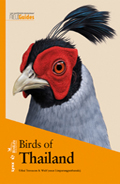
Birds
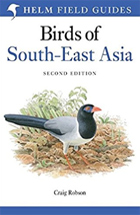
of Thailand This field guide has set new standards in identifying
birds in the wild in Thailand. With the most up-to-date
taxonomy of any publication this is the book you need
if you are birdwatching in Thailand. Forget all of the
older guides and buy this one.
Bird
Watching Trips:
Bang Poo is a good site for a half-day of birding and
makes a nice final stop on any birding itinerary finishing
in Bangkok; great for close-up photos of gulls and there
is always the chance of a rarity here.
I Hope
You Enjoyed This Page
If you found the information you were looking for here
please let others know by liking this page on Facebook
and Tweeting it.












 Download
a full
Download
a full