Klong Si Yat Reservoir, in Chachoengsao
province, is a shallow lake formed by a dam across Klong Si
Yat which has farmland and woodland around its edges. For
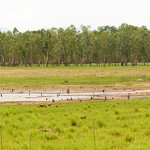
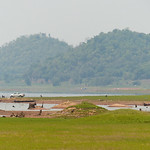
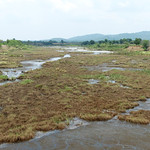
much of the year the water level is high but in the late dry
season water levels recede and large areas of marginal habitats
form, including large areas of wet grassland; this lasts into
the early rainy season until water levels are replenished
in September and October. Permanent scrub and marshy areas
close to the dam mean that there is quite a patchwork of habitats
here, making for high biodiversity and, of course, plenty
of birds.
This reservoir is a good site for seeing a number of the ground-nesting
birds that occupy grassland habitats but the site lacks any
really rare species that make it worth making a special visit.
However, this is a great place to spend a morning, at the
right time of year, if one is in the area or passing through.
Certainly Klong Si Yat reservoir is a site where birders
can see a large number of species in a morning and many birds
are approachable in a car, when the water levels are low,
making this a good site for bird photography.
Although most of the species that occur at Klong Si Yat
reservoir are commoner water birds and open country birds,
there are a few scarcer species that can be found at the site.
Vinous-breasted Myna is tricky to find in most of Thailand
and although it is not common at Klong Si Yat, it can be found
with a little effort. Bright-headed Cisticola and Oriental
Skylark are two more species which are not common throughout
Thailand and both are resident in the grassy areas around
the lake, with the latter being very abundant when the water
level is low.
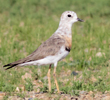
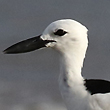
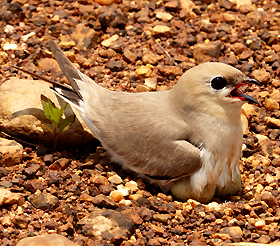
Small Pratincole is a species which is getting rarer as the
Mekong river becomes increasingly degraded, but a small breeding
population at this site indicates that they may be able to
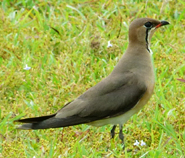
adapt to other areas; Oriental Pratincole is very abundant
here as the water level goes down in February to July.
Oriental Darter is another scarce (although increasing) bird
which is present at Klong Si Yat in small numbers and with
waders passing through on migration there is the chance of
something rare turning up.
Use the interactive map below to plan your route
to Klong Si Yat Reservoir. The blue line shows the route from
the Chachoengsao (Blue Pin) to Klong Si Yat Dam (Red Pin)
via Phanom Sarakham (Green Pin).
Getting to Klong Si Yat reservoir is fairly easy if you
are driving your own vehicle. Firstly, head to Chachoengsao
and then take highway 304 to Phanom Sarakham - it is signposted
on the highway. Upon reaching Phanom Sarakham turn right at
a junction towards the town of Sanam Chai Khet and pass through
the town on route 3245. As one passes all the shops in Sanam
Chai Khet there is a signpost for Khao Ang Rue Nai Wildlife
Sanctuary; turn right here and keep following this road (route
3259) until eventually seeing a signpost to turn left to Klong
Si Yat Reservoir - the dam is a few kilometres down a potholed
road.
Should you attempt to reach the reservoir by public transport
it is probably possible by taking a bus from Phanom Sarakham
to Wang Nam Yen and getting off near the reservoir, but it
would leave you with long distances to walk in very hot weather
so I would not recommend visiting this location without your
own transport.
Bird
Watching Trips:
If you need help organizing a bird watching trip to Thailand,
take a look at the suggested itineraries for ideas on
creating a tailor-made trip and contact me for advice:
Thailand
bird tours.
Finding Birds
Finding birds at open-country sites is always fairly easy,
with birds such as Asian Openbill, Lesser Whistling Duck,
Oriental Darter and Egrets found at various points on the
water's edge. Other species, however, will be found in various
habitat patches depending on their preference.
Woodland
: A number of patches of woodland/forest exist around
the reservoir and while most of them are not large enough
to support much of an avifauna, some of them are remnants
of original forest and close to areas of more extensive forest,
so the possibility of finding some interesting species is
good. Additionally, the woodland on the lake's edge, close
to the dam, is likely to attract passage migrants at the right
time of year (September/October & March/April). I have
only recorded common species such as Pin-striped Tit Babbler,
Lineated Barbet and Dark-necked Tailorbird but the scope for
adding new species to the site list from these woodland areas
is high.
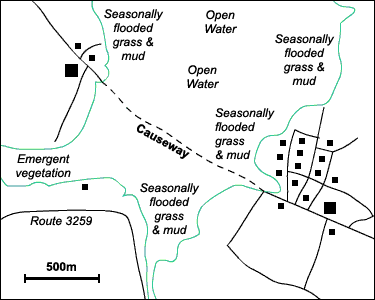
The
"Causeway End" of the Lake : When
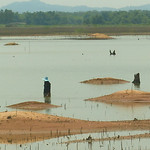
the water level of the reservoir is low a causeway is revealed,
which is the old route of highway 3259, which has now been
diverted. At these times there is also a large area of marginal
habitat exposed; wet grassland, emergent vegetation, mud and
shallow water which attracts large numbers of birds.
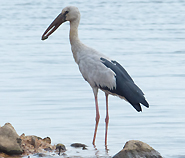
Asian Openbills continue to expand their range throughout
Thailand and this species is obvious, feeding at the water's
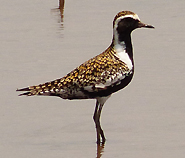
edge, as soon as one arrives. Red-wattled Lapwings and Black-winged
Stilts are also easily spotted but it is worth scanning the
water's edge for wintering/passage shorebirds with species
such as Common Sandpiper, Pacific Golden Plover, Common Greenshank
and Wood Sandpiper likely with many others possible - perhaps
even a rarity at the right time of year?
Between February and July (and probably into August) large
numbers of Oriental Pratincoles are present, breeding on the
open areas and can often be observed at close range, but be
careful not to trample their nests - they will feign injury
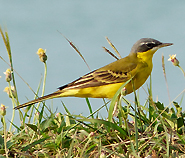
and lead you away from their eggs and/or young. Eastern Yellow
Wagtails can be seen on the wet grassland, with large numbers
present when they are migrating, and ground-nesting species
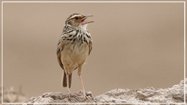
such as Indochinese Bushlark, Paddyfield Pipit and Oriental
Skylark being very obvious and numerous - driving slowly across
the causeway will allow birders to get close-up views of these
birds.
Using the causeway is the best way to get out onto the large
areas of habitat and it is best to park the car on the side
of this old road and walk out onto the grass and mud to find
birds such as Greater Painted-snipe, Pintail Snipe, Pipits
and Wagtails as well as scanning for waterbirds and waders.
However, when this causeway is exposed, local traffic uses
it as a short cut, with a steady stream of trucks and pickups,
so be careful when driving and walking out here.
This end of the reservoir is where the water is always at
its shallowest and even when the water level is high there
is emergent vegetation, which will contain Oriental Reed Warbler
in the dry season and birds such as Eastern Great Egret, Little
Cormorant, Pied Kingfisher, Lesser Whistling Duck and others
all year round; this is also a good place to look out for
Oriental Darter.
This area does get busy with locals fishing, swimming and
even washing their vehicles, so it is best to get here early,
before disturbance becomes a problem.
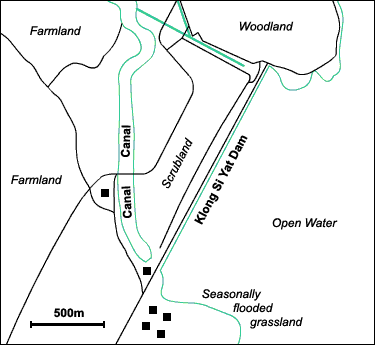
The
Dam : To the west of the dam is a patchwork
of habitats which differs significantly to that around the
rest of the lake, with dry scrubland, irrigation ditches and
marshland which give birders the opportunity to come up with
a big day list! A network of small roads criss-cross this
area, making it good for approaching birds closely in a vehicle.
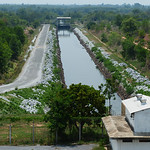
Originating from the dam itself is a canal, to collect overflow
water, which forms a marshy habitat favoured by species such
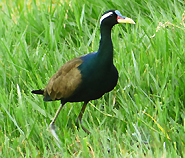
as Bronze-winged Jacana, Egrets, Little Cormorant and perhaps
Crakes. The canal is lined with Typha and sedge which
will attract Reed Warblers and other skulking species and
a good sized population of Baya Weavers nests in trees and
bushes along here; walking along the edge of this canal could
be rewarding when migrant species are present in the dry season.
In between the dam, service roads and various canals is an
area of scrubland, containing some small pools and ditches
where typical species of this habitat exist; Plain Prinia,
Pied Fantail, oriental Magpie Robin, Black Drongo, Mynas,
Eastern Cattle Egret and Indochinese Bushlark, which is very
numerous here. This area has potential for finding migrants
in winter and during migration, a few Thick-billed Warblers
were present in April 2014 and migratory Starlings are possible
at other times - this would be a good place to find migratory
passerines at the right time of year.
Plain-backed Sparrow is a bird which is much more attractive
than its name suggests, with the male's brick red back and
yellowish underparts, and several pairs can be found breeding
around this area - particularly near the near bridge over
the canal.
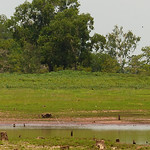
The seasonally flooded grassland to the southeast of the dam
actually consists of rocky and scrubby areas interspersed
by grass and here is where a few pairs of Small Pratincoles
nested in 2014; scan hard for them and try to avoid disturbing
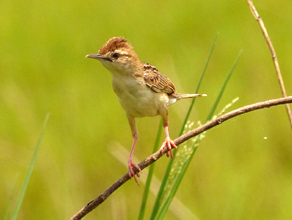
them. Lots of Zitting Cisticola and Paddyfield Pipits are
to be found and Bright-headed Cisticola breeds on the edge
of the farmland found area here; a few pairs of Black-winged
Stilt seem to nest in this area too and there are also breeding
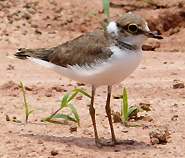
Little Ringed Plovers.
Farmland : Agricultural
land in this region is very intensively farmed and not many
other species of interest are likely to be found. The commoner
open country species such as Sparrows, Indochinese Bushlark,
Mynas etc. are all that is likely to be seen. Black-winged
Kite hunts in the farmland, though, and it is possible that
Rufous-winged Buzzard is in the area - it favours large, dry
trees in open country and farmland
Although there are only a few small villages in the region
of the reservoir there are a surprising number of accommodation
options around the lake. In the village of Ban Nong Dok there
are several guesthouses, some close to the lake, which are
cheap but rather dark and uninviting.
Far better options are three rather newer accommodation options;
one brightly-coloured "resort" a few hundred metres
west of Ban Nong Dok, on Route 3259, with clean, air-conditioned
rooms; Sornlai Homestay, on the northern side of the lake,
with pleasant-looking, clean bungalows and a restaurant; and
Chalet Resort, very conveniently placed, close to the dam.
Near the dam and close to the "causeway" road are
some small restaurants where food and cold drinks can be found
(it is wise to carry cold water with you as it gets extremely
hot here) and there are a variety of small shops and food
stalls at Ban Nong Dok.
Klong Si Yat Reservoir is not a National Park and there is
no entry fee to go birding at this location.
Some Useful Books
Birds
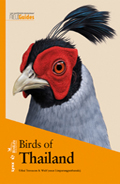
of Thailand This field guide has set new standards in identifying
birds in the wild in Thailand. With the most up-to-date
taxonomy of any publication this is the book you need
if you are birdwatching in Thailand. Forget all of the
older guides and buy this one.
The
Ecology and Conservation of Asian Hornbills This informative book has everything a birder would
want to know about the ecological importance of Asian
Hornbills in their forest habitat. A wonderful reference
book for birders interested in these iconic birds.
Bird
Watching Trips:
Klong Si Yat Reservoir is a good place to see a lot of
birds in a single morning at the right time of the year.
Although it is not a site that is one of the "must-visit"
locations it fits well into longer itineraries for birding
in the southeast region.















 Download
a full
Download
a full