Note: This article
was originally published in Birding Asia 11 (2009) the bulletin
of the Oriental
Bird Club (OBC) and was kindly submitted by Philip
D. Round.
We report recent occurrences of Fire-tailed Sunbirds Aethopyga
ignicauda on the mountain of Doi Lang, Mae Ai District,
Chiang Mai Province, north-west Thailand, and comment on some
identification features of this species.
Between 18–19 December 2007, we trapped four Fire-tailed
Sunbirds, apparently two males and two females, at an elevation
of 2,000 m on Doi Lang (20º06’N 99º08’E),
the north-east ridge of the mountain of Doi Pha Hom Pok, in
mist-nets set in roadside herbage on an exposed, open, scrubcovered
ridge that runs north to south. The birds were ringed with
metal bands (internal diameter 2.0 mm) supplied by the Department
of National Parks, Wildlife and Plants Conservation, Thailand
(Table 1).
Table
1: Biometric and moult data of four Fire-tailed Sunbirds
Aethopyga ignicauda compared with Gould’s Sunbirds
A. gouldiae.
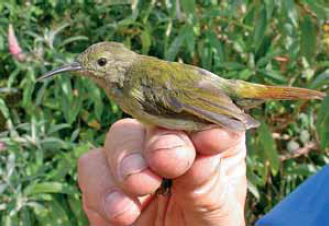
Plate
1: Presumed female Fire-tailed Sunbird, Doi
Lang,
Thailand, 18 December 2007.
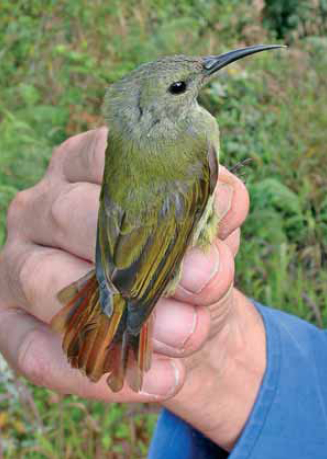
Plate
2: Presumed female Fire-tailed Sunbird, Doi
Lang, Thailand, 18 December 2007.
The birds were apparently visiting the pink flower-spikes
of Buddleja macrostachya Benth. (Buddlejaceae)
during cloudy weather, as fewer sunbirds were present on the
two following days, in sunny conditions. Gould’s Sunbirds
A. gouldiae were also present.
Fire-tailed Sunbirds were seen subsequently and intermittently
at the same site up to 17 February 2008 by many observers,
and some were photographed. There were possibly as many as
seven individuals present in total that winter, as three unringed
birds were reported between 8–10 February 2008 (Dr Kaset
Sutasha in litt.).
Remarkably, two of the four ringed Fire-tailed Sunbirds (both
females) were retrapped at the same site one year later, on
24 December 2008, by the authors, Worapoj Boonkhwamdee, J.
N. Dymond, Andrew J. Pierce and Prateep Rojanadilok (Head
of Doi Chiang Dao Wildlife Research Station, Chiang Mai).
On the second occasion these were the only Fire-tailed Sunbirds
caught among 42 Gould’s Sunbirds and two Black-throated
Sunbirds A. saturata. Although the species is possibly
a regular visitor to the site, it would appear to be genuinely
scarce.
The only previous Thai record of Fire-tailed Sunbird was an
unsexed immature specimen collected by Ben King at 2,040 m
on the same mountain (Doi Pha Hom Pok) on 11 November 1965.
This paucity of records is perhaps surprising given the frequent
coverage by birdwatchers of the Chiang Mai mountains. Fire-tailed
Sunbird may therefore be genuinely scarce in NW Thailand,
where there is very little terrain above 2,000 m, much of
which is difficult to access.
Fire-tailed Sunbird breeds along the Himalayas from Himachal
Pradesh eastwards to Bhutan, Assam, north and west Myanmar,
and northwards to Tibet and Yunnan, chiefly in conifer forest,
at elevations of 3,000–4,800 m (Cheng 1987, Robson 2000,
Cheke et al. 2001, Rasmussen and Anderton 2005).
Although usually said to be a resident or altitudinal migrant,
descending to 610–2,900 m in winter (Cheke et al.
2001), it is by far the commonest sunbird on migration in
Yunnan, with more than 16,000 Fire-tailed Sunbirds seen migrating
north along a 2,500 m ridge on Gaoligongshan during ten days
in early April 1996 compared with only 974 Gould’s Sunbirds
during the same period (J. Hornskov in litt.).
Sunbirds are fast-moving and difficult to identify. Female
sunbirds are also inadequately described and depicted in most
existing guides. In Robson (2000) neither text nor illustrations
are fully revealing as to how the combination of characters—either
yellow rump-patch and/or tail spots—are distributed
among females of the similar Green-tailed A. nipalensis,
Gould’s and Black-throated Sunbirds. This could easily
lead to female or early immature Fire-tailed being overlooked.
Female and early immature Fire-tailed Sunbirds possess only
an indistinctly defined, slightly yellower rump, and no more
than a suggestion of pale tail feather tipping. They are more
easily defined by the field characters they lack rather than
those they possess. All four birds trapped in 2007 showed
dull brownish-red edges to the rectrices and an illdefined,
slightly paler, yellowish area on the rump. All were in active
wing moult. Two birds, with an orange-red spot on the centre
of the breast, were presumed to be first-winter males, and
one of them had a few red feathers on the uppertail-coverts.
Possibly the best distinctive feature of a female or immature
Fire-tailed Sunbird is its longer bill compared with Gould’s
Sunbird (bill to skull 22.0– 24.3 mm in four Fire-tailed
measured, compared with mean 18.6 ±0.98 mm, range 16.7–22.1
mm, n = 36, both sexes combined, for Gould’s Sunbird;
see Table 1). J. Hornskov (pers. comm.) has also
commented that Fire-tailed Sunbird is readily distinguishable
from Gould’s Sunbird by its Grey Wagtail Motacilla
cinerea like call (not heard by the authors).
ACKNOWLEDGEMENTS
We thank Ms. Wangworn Sankamethawee for her identification
of the Buddleja and Jesper Hornskov for permission to quote
his unpublished observations. We thank Ms. Kalayanee Boonkerd
and Ms Duangrat Pothieng, Wildlife Research Section, Department
of National Parks, Wildlife and Plants Conservation, for making
rings available.
Cheng Tso-Hsin (1987) A synopsis of the avifauna of China.
Beijing: Science Press.
Ginn, H. B. & Melville, D. S. (1983) Moult in birds.
British Trust for Ornithology Guide Number Nineteen.
Tring: British Trust for Ornithology.
King, B. (2007) Some 1960s additions to the list of Thailand’s
birds. Nat. Hist. Bull. Siam Soc.55
(1): 105–119.
Rasmussen, P. C. & Anderton, J. C. (2005) Birds
of South Asia: the Ripley guide.Washington, D.C.
and Barcelona: Smithsonian Institution and Lynx Edicions.
Philip D. Round, Assistant Professor and Regional Representative,
The Wetland Trust, Department of Biology, Faculty of Science,
Mahidol University, Rama 6 Road, Bangkok 10400, Thailand Email:
frpdr@mahidol.ac.th
Akalak Kunsorn, c/o Doi Pha Hom Pok National Park, P. O. Box
39, Tambol Pong Nam Ron, Fang, Chiang Mai 50110, Thailand
Email: akunsorn@hotmail.com




 Download
a full
Download
a full