Hellfire Pass
(Updated 13/04/19) |
Introduction |
|
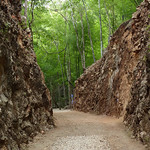
Hellfire Pass is the sinister nickname given to Konyu cutting,
of the Thai-Burma railway, by the Allied prisoners of war
that were forced to work on it during World War II. This stretch
of the railway bed is located close to the famous river Kwai,
and there is still a lot of secondary forest located along
the route as vegetation continues to grow after clearance.
A 4.5km walking trail through the forest, following the railway
makes this a fairly interesting birding location and birders
travelling with a non-birding partner can use the interesting
and thought-provoking museum as an excuse to visit and get
into the forest. Although quite a number of nice birds can
be seen as one walks along the trail, the main reason for
visiting this location is for those with an interest in the
history of the events of World War II in Southeast Asia; I
include Hellfire Pass as a site which offers bird watchers
a chance to see Limestone Wren Babbler (Greyish
Limestone-babbler if you follow HBW taxonomy)- a species
with a restricted range in Thailand.
When walking the trail, sweating and being bitten by the extremely
numerous mosquitoes, spare a thought for the prisoners of
war and Asian labourers who were forced to work in these conditions
with insuficient food and water until they dropped! There
are some interesting birds to be seen at Hellfire Pass, but
overall this is a very sombre place full of history. |
|
|
Birding Highlights |
|
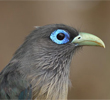
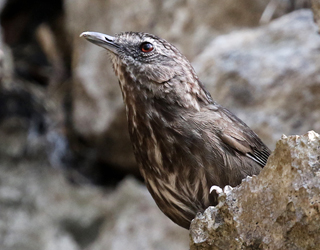
The ornithological highlight here is undoubtedly Limestone
Wren Babbler. This species has very a restricted range in
Southeast Asia, being confined to areas with outcrops of limestone,
as its name suggests. Two subspecies exist in Thailand; crispifrons,
which is dark brown/grey and fairly large, and this is the
race found at Hellfire Pass; the other race in Thailand is
calcicola, which is smaller and more rufous in colouration,
resembling Streaked Wren Babbler and is found only in Saraburi
and Lopburi provinces of central Thailand.
Limestone Wren Babbler really is the stand-out bird here but
a walk along the trails will give birders the opportunity
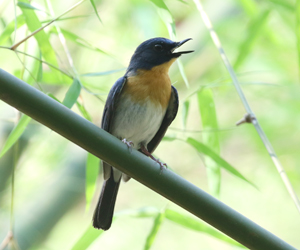
to see many other common forest species, such as Tickell's
Blue Flycatcher, Black-hooded Oriole, Greater Necklaced Laughingthrush
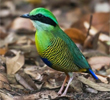
and Lesser Necklaced Laughingthrush. In the wet season Blue-winged
Pitta can also be found and there is a lot of potential to
add to the very incomplete checklist for the site, particularly
if visiting during migration.
A checklist of the birds for this location can be found here
- Hellfire
Pass |
 |
Travel Information |
Use the interactive map below to plan your route to
Hellfire Pass. The blue line shows the route from Kanchanaburi
(Blue Pin) to Hellfire Pass (Red Pin). |
|
|
By Car/Motorcycle
Getting to Hellfire Pass is a simple affair. If driving, head
towards Kanchanaburi (pronounced Garn Ja Na Boo Ree) and take
the main road towards Sangkla Buri on the Thai/Myanmar border.
After around an hour the Hellfire Pass war memorial museum
can be seen on the left; there is ample car parking here.
By Bus
Arriving by public transport really is not much more difficult.
Buses to Kanchanaburi originate from all nearby provincial
capitals, but if coming from Bangkok one must go to the Southern
bus terminal where there are buses that leave every 30 minutes.
From Kanchanaburi any bus going to Sangkla Buri will stop
to let you off at the memorial museum and equally it should
be easy enough to flag a bus down for the return journey.
The bus journey from Bangkok takes around 2.5 hours and from
Kanchanaburi to Hellfire Pass can take quite a while due to
the poor standard of the buses. On the way back to Kanchanaburi
it may be worth hitch-hiking which is quite easy and safe
in Thailand and can be quite entertaining; anyone with an
open-backed pickup is likely to stop for you.
By Train
There is also the option of getting to Kanchanaburi by train.
If this interests you then head to Thonburi train station
in Bangkok. This trip is reported to take 2 hours 40 minutes
with third class being tolerable and offering some nice sights
along the way. From Kanchanaburi motor scooters can be rented
or local transport can be organized. |
 Bird
Watching Trips: Bird
Watching Trips:
If you need help organizing a bird watching trip to Thailand,
take a look at the suggested itineraries for ideas on
creating a tailor-made trip and contact me for advice:
Thailand
bird tours. |
|
Finding Birds |
This location isn't one which is on the regular birding
circuit in Thailand as it is not particularly rich in birdlife,
however, it remains one of the only places that I have seen
the sought-after Limestone Wren Babbler which is relatively
easy to see. The walking trail offers a chance to see plenty
of other common forest birds. |
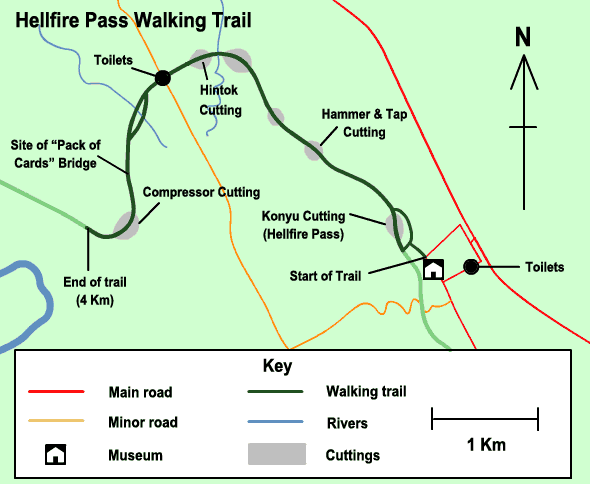
|
There are a few places at this location where birds characteristic
of the habitats may be found;
Museum Entrance
Area: Common species associated with open country
can be seen around the car park and in the surrounding trees,
including White-rumped Munia, Common Iora, Olive-backed Sunbird,
Sooty-headed Bulbul and Common Tailorbird.
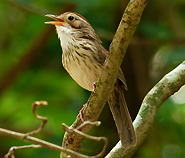
Puff-throated Babbler
|
|
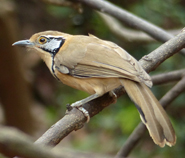
Greater Necklaced Laughingthrush
|
|
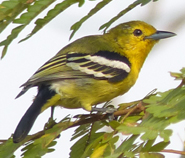
Common Iora
|
|
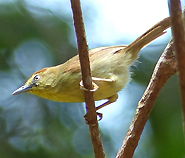
Pin-striped Tit Babbler
|
| (Photos by Nick
Upton) |
Konyu
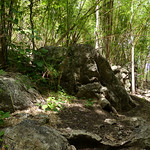
Cutting Trail: This narrow winding trail goes
through bamboo forest and rocky outcrops and runs for a few
hundred metres. This trail perhaps offers the best chance
to see Limestone Wren Babbler; I have seen it on all three
of my visits, spanning a time frame of 17 years. The babblers
can come quite close so be ready with your camera for photographs
and be careful of slippery and collapsing steps (in fact the
beginning of the trail has been re-routed and the crumbling
steps over the rocks have been closed). Birds such as Yellow-bellied
Warbler, Tickell's Blue Flycatcher, White-rumped Shama and
Puff-throated Babbler are also very likely to be encountered
along here.
Walking Trail:
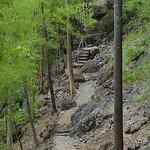
The 4.5 kilometre long walking trail follows the route of
the old railway, proceeding mainly along forest edge, where
birds such as Striped Tit Babbler and Black-naped Monarch
live, with some picturesque viewpoints over the surrounding
countryside. The forest here consists of a mixture of bamboo
and trees (both native and non-native) on a steep rocky slope.
Limestone Wren Babbler inhabits this area too but can be hard
to observe as it jumps around the rocks and flocks of Greater
and Lesser Necklaced Laughingthrush can turn up anywhere along
here. Listen for Black-hooded Oriole and Hill Myna and you
may spot them perched in the larger trees and Bulbuls will
be seen feeding on fruit and flowers in the canopy.
Make sure you take some water and insect repellent with you
if you are walking the length of this trail, it can get extremely
hot and the mosquitos are rampant! |
Facilities |
 |
There is not much in the immediate vicinty of Hellfire
Pass but at the museum itself there is a parking area as well
as a small restaurant and a couple of coffee shops that sell
simple food and very welcome cold drinks; clean toilets for
visitors are also located here.
About 25 kilometres away is a village where Nam Tok railway
station is located and there are several cheap guesthouses
and several convenience stores here as well as ATMs. Scattered
all along the valley are a series of resorts of varying quality
and cost, most of which are situated a little off of the road,
alongside the river. I have never stayed in any of these so
cannot recommend anything in particular.
In the town of Kanchanaburi itself there is all sorts of accommodation,
ranging from quite luxurious hotels to grubby backpacker guesthouses:
Kanchanaburi
Hotel Reservations. On my last visit in early 2019
I stayed in Serene
Residence which was very comfortable and clean with
breakfast included in the price, although this does not start
until 7am. Kanchanaburi is a fairly busy town and anything
can be purchased here; the fruit market is pretty good and
I would recommend Durian, Mangosteen and Rambutan. The town
also has supermarkets, pharmacies, all varieties of restaurants
and hospitals should birders require any of these. In and
around Kanchanaburi are the war cemeteries where thousands
of Allied prisoners of war that died working on the railway
are buried. These cemeteries are very well kept and thought-provoking
places.
Hellfire Pass is not a National Park and there is no entry
fee to go birdwatching there, although in the museum there
is a donations box to help with the upkeep of the exhibits
and walking trails. |
Useful Books |
|  Birds
of Thailand
Birds
of Thailand
This field guide has set new standards in identifying
birds in the wild in Thailand. With the most up-to-date
taxonomy of any publication this is the book you need
if you are birdwatching in Thailand. Forget all of the
older guides and buy this one.
|
 How
Birds Migrate How
Birds Migrate
This is one of the most informative books on birds
that I have ever read. Covering all aspects of bird
migration this is a great read for broadening your knowledge.
There are usually some cheap second-hand copies available
through the link above.
|
|
Other Related Pages |
Hellfire
Pass Bird Checklist
Thailand Birdwatching
Tours
Other Western Thailand Birding Locations
Limestone
Wren Babbler at Wat Pra Phutthabat Noi |
Trip Reports |
Hellfire Pass &
Laem Pak Bia, October 2008 - by Stephen Totterman
Hellfire
Pass, 11th July 2002 - by Nick Upton |
 Birdwatching
Trips:
Birdwatching
Trips:
Hellfire Pass makes a nice morning's birding as part of
a longer birding trip, visiting other nearby sites, or
if you wish to see the nominate race of Limestone Wren
Babbler. The calcicola subspecies is easy to
see in Saraburi and fits more sensibly into longer birding
itineraries.
Take a look at some suggested itineraries and contact
me for more information: Thailand
bird tours. |
|
Related Blog Entries |
|
Photo Galleries |
Select the thumbnail photos to see larger images. |
|
Around Hellfire Pass
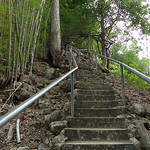
Limestone Stairway |
Wren Babbler habitat |
Walking Trail |
Hellfire Pass |
Symbolic Tracks |
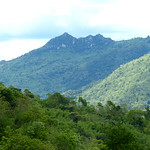
Scenery |
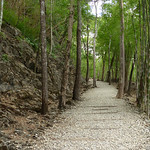
Walking Trail |
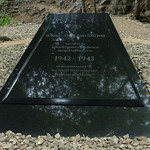
Memorial |
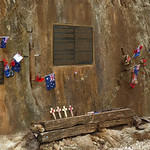
Remembrance |
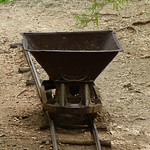
Rail Equipment |
More Birds at Hellfire Pass

White-browed Scimitar Babbler |

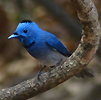
Tickell's Blue Flycatcher |

Limestone Wren Babbler |

Ashy Woodswallow |

Puff-throated Babbler |
|
Selected eBird Lists |
- 11
April 2019, Hellfire Pass, Kanchanaburi - by Nick
Upton
- 08
September 2018, Hellfire Pass, Kanchanaburi - by
Wei An See
- 08
March 2018, Hellfire Pass, Kanchanaburi - by Ben
Weil
- 28
October 2017, Hellfire Pass, Kanchanaburi - by Natthaphat
Chotjuckdikul
- 10
May 2014, Hellfire Pass, Kanchanaburi - by Nick
Upton
- 11
July 2002, Hellfire Pass, Kanchanaburi - by Nick
Upton
|
|
|
|
|
I Hope You Enjoyed
This Page If you found the information
you were looking for here please let others know by
liking this page on Facebook and Tweeting it.
|
|
|
If you found this page useful and want to say thanks, you
can buy me a beer.
 |
|
|
|




 Download
a full
Download
a full