| Khao
Soi Dao Wildlife Sanctuary |
| Introduction |
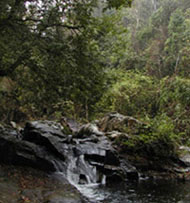
Stream, Khao
Soi Dao
(Photo by Vincent
van der Spek) |
|
Khao Soi Dao Wildlife Sanctuary is part
of the highest mountain range in south-eastern Thailand and
forms a large wilderness area with the adjacent Khao Kitchakut
National Park. As part of the Cardomom mountains, much of
the avifauna found here is more closely related to that found
in Cambodia than that of the rest of Thailand. Indeed, a few
species can only be found in this region and a number of distinct
subspecies are unique to this area as well.
Khao Soi
Dao is in one of the wettest regions of the country and the
lush forest found here is quite spectacular with one of the
most picturesque waterfalls of any location in Thailand, with
fabulous views over the rainforest from the top for those
with the energy to climb up. This is a good place to go birding
before or after a relaxing visit to the nearby Ko Chang, and
an opportunity to get to an area of excellent habitat which
is rarely visited by groups of birders. This wildlife sanctuary
has a reasonable park infrastructure and a few good trails
which give bird watchers the opportunity to find some very
seldom seen species. |
|
|
About
Google adverts |
| Birding
Highlights |
Blue-rumped
Pitta would have to be the pick of all the species occurring
at Khao Soi Dao and indeed, in Thailand this species is restricted
to this wildlife sanctuary and its immediate surroundings.
Black-browed Fulvetta is another bird which is restricted
to this part of Thailand as is the lewisi subspecies
of Silver Pheasant.
Khao Soi
Dao seems to be a consistently good place to see Needletails
with White-throated Needletail recorded here fairly often,
even though it is the rarest of Thailand's Needletail species.
The secretive Malayan Night Heron is another bird which seems
to pop up at Khao Soi Dao more often than it does in other
places and a sighting of this species alone would be reason
enough to visit the sanctuary. The quality of the forest at
Khao Soi Dao is such that a very large number of forest species
can be found. Pompadour Pigeon can sometimes be seen near
headquarters and this is also a good place to get close views
of Violet Cuckoo, Asian Barred Owlet and Dusky Broadbill. |
|
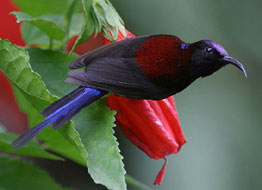
Black-throated
Sunbird
(Photo by Alister
Benn) |
|
Spending
time in this Wildlife Sanctuary could reward birders with a long
and exciting list of species as well as giving them the opportunity
to add to the current checklist. |
| Click
here for a checklist of the birds of Khao
Soi Dao Wildlife Sanctuary |

|
|
Birdwatching
Trips:
if you need help organising a birdwatching trip to Thailand,
take a look at the suggested itineraries for ideas on
creating a tailor-made birdwatching trip and contact me
for advice: Thailand
bird tours. |
|
|
| Travel
Information |
|
|
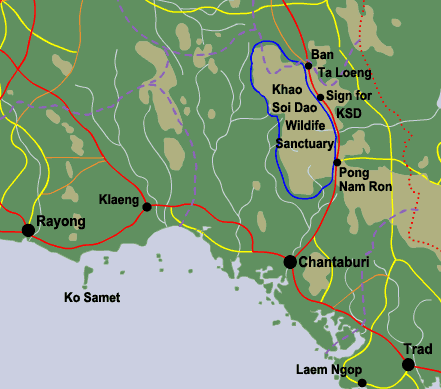
Khao
Soi Dao is easy to get to and is ideal for people using public
transport. From Ekamai (Eastern) bus station on Sukhumvit
Road in Bangkok a bus to Chantaburi will take around 5 hours.
From the bus station in Chantaburi take any bus going north
towards Sa Kaeo on highway number 317. At the 62nd kilometre
marker there is a sign with "Khao Soi Dao Waterfall"
written in English. Get off the bus here and walk the 4 kilometres
to the Wildife Sanctuary or hitch a lift. There are a couple
of small shops at this junction and it would be possible to
arrange a lift to the Wildlife Sanctuary HQ from one of these.
It is also possible (and perhaps advisable) to get off at
the town of Soi Dao (just past the sanctuary turn off) and
take a motorcycle taxi or tuk tuk to the HQ.
About
20 kms south of the turning for the HQ is a turning for Khao
Soi Dao Dtai (South). Birders can camp here and climb the
mountain, but it is not easy to find the trail and I've been
told that the HQ and waterfall area is probably a better option
for most birders. Details of this location are given in Charles
Davies's trip report. |
|
|
About
Google adverts |
| Finding
Birds |
Just
hanging around Headquarters will reveal plenty of interesting forest
birds with Hill Myna, Pompadour Pigeon, Dusky Broadbill, Banded
Broadbill and Large-tailed Nightjar all present on both occasions
that I have visited the Wildlife Sanctuary. There are a few trails,
however, which will get one further into the forest.
In order to
see most of the regional highlights, it seems that it is necessary
to get higher up the mountain than the HQ region and hiking uphill
from the waterfall would be the best option; following the stream
will reduce the chances of getting lost. In order to spend enough
time at the right altitude for species such as Blue-rumped Pitta,
Eastern Green Magpie and Siamese Partridge, rough camping would
seem necessary. |
|
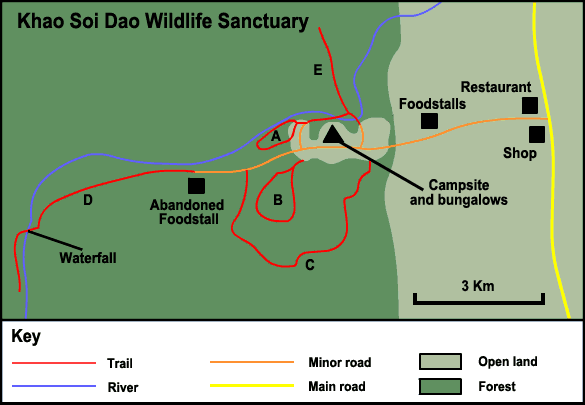
Campsite
and bungalows :
There is some excellent general birding around the
campsite and bungalows where there is a small pond and some
damp patches which seem to attract birds. A number of Flycatchers
can be seen around here with Verditer Flycatcher often perched atop
dead trees and Asian Brown, Yellow-rumped and Taiga (Red-throated)
Flycatchers are often to be found in this area. Violet Cuckoo and
Dusky Broadbill seem to be unusually frequent around here and the
open aspect of the campsite is an ideal place to look for Needletail
Swifts, with all three Thai species possible at various times of
the year.
In the wet season
Blue-winged Pitta is common in and around this area as are Banded
Broadbill, Banded Kingfisher and many other breeding birds.
At dusk
this is a good place to watch for Great Eared and Large-tailed Nightjars
and rare species such as Malayan Night Heron and Javan Frogmouth
have also been seen. A Spot-bellied Eagle Owl territory has been
occupied for some time just beyond the HQ clearing in this region;
listen for it at dusk, although apparently it can be quiet for long
periods. |
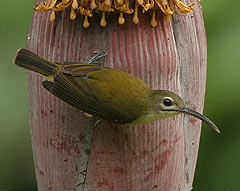
Little Spiderhunter
(Photo by Albert Noorlander) |
|
Road
to waterfall car park :
Early in the morning this road is ideal for birders, although
at weekends it can get a little busy later in the day with
people heading to the waterfall; the gate is open for cars
to use this road between 9am and 4pm. Banded Kingfisher is
often heard and seen along this track and Green Pigeons frequently
fly overhead. This can be an excellent place in the early
morning and sightings of Oriental Pied, Great and Wreathed
Hornbills attest to the quality of the forest here. Banded
Broadbill and Orange-breasted Trogon are colourful and frequent
additions to the trip list along this road and this is also
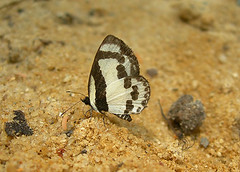
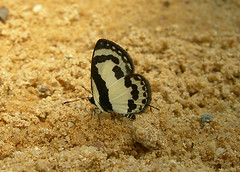
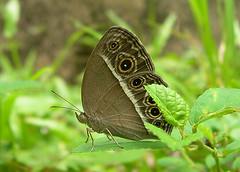
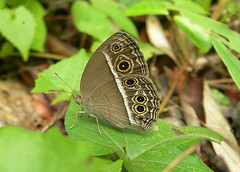
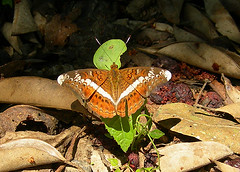
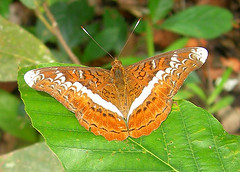
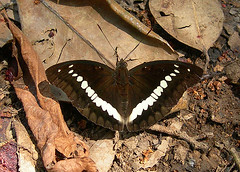
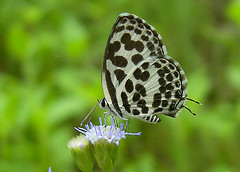
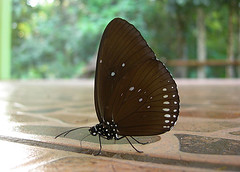
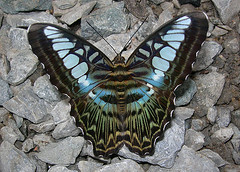
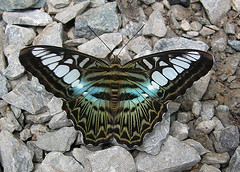
a good place to watch butterflies. Asian Barred Owlet seems
to frequent this area too.
Toilets
are present where the road finishes and the trail begins but
there is no food here so it is useful to take breakfast before
birding the road and heading onto the waterfall. The road
opens to vehicles at 9am and closes again at 4pm. |
|
Trail
A :
A small loop which partly
follows the river. Before the gate to the waterfall turn right and
there is a large birdcage with some pheasants and ducks in it. Before
the cage there is a small road to the left, follow this and you
will come to a small house. Opposite this house is the entrance
to the trail. In the winter this is a nice trail with good flocks
of birds including Oriental Pied Hornbill. Orange-headed Thrush
and Blue Whistling Thrush both occur along this trail but in the
wet season there don't seem to be many birds.
Trail
B :
This trail is easy to find as the entrance is marked by a bridge.
At the start (or end, depending on which side you start) you have
to cross a small stream which can be strong during the summer. The
halfway point on this trail is a nice viewpoint where raptors including
Besra, Crested Serpent Eagle and Rufous-bellied Eagle have been
seen. It is also an ideal place to watch for Needletails and Swallows.
Trail
C :
This long trail can be quite hard to find. Just after the main entrance
there are some houses/offices at the left site. Behind the offices,
in the left corner, is the entrance to this trail. This trail passes
through an enormous tree and along here some good birds have been
found including Red-headed Trogon, Orange-breasted Trogon, Silver
Pheasant, Banded Kingfisher, Great Eared Nightjar (during daytime!)
and Blue Pitta. It ends somewhere on the road to the waterfall. |
| Waterfall
Trail (Trail D)
: This takes birders
through the forest and up to a wonderful waterfall. It is
possible to cross the river at the bottom of the falls and
then climb to the top for an excellent view. The forest is
good for birds with Blue-rumped Pitta and Silver Pheasant
being the specialities to look for. Beyond the waterfall one
can climb to the mountain summit and look for Siamese Partridge.
In the wet season there can be lots of annoying leeches in
the vicinity of the waterfall so it is a good idea to bring
leech socks!
Trail
E :
This trail crosses the river and
forks into two long trails through the forest. I haven't explored
them fully, but I'm told one eventually ascends Khao Soi Dao
Neua and the other eventually emerges at the western boundary
of the sanctuary; I once followed the trail for about 1 kilometre
and saw a flock of Pompadour Pigeons feeding on a fruiting
tree.
|
|
|
|
|
Birdwatching
Trips To Khao Soi Dao:
If you have only a day or two
for birding from Bangkok, Bang Pra is an |
excellent location, coupled with a visit to Muang
Boran Fishponds. At any time of year a good selection
of colourful birds are present and in the dry
season a whole range of migrants visit this location.
Contact
me to arrange a trip and/or to discuss the best
birdwatching options for you: nickupton@thaibirding.com |
|
|
|
| Facilities |
Although
accommodation can be arranged it must be done in advance and
it is highly unlikely that you will be given a roof over your
head if you just show up. For those that want to be right
in the forest it is advisable to come prepared to camp at
Khao Soi Dao. I have camped here, and to my knowledge it is
essential to bring ones' own tent, but the campsite is conveniently
placed and even during busy periods is not too crowded and
there are toilets available.
A number
of foodstalls 200 metres before HQ have a good range of cheap
Thai food and a selection of drinks. There is also a small
restaurant just to the left of the entrance gate as one goes
into the wildlife sanctuary where the staff are helpful and
cook tasty meals until about 6pm.
For those
needing to stay in Chantaburi, there are a number of fairly
decent hotels a short walk from the bus station. |
|
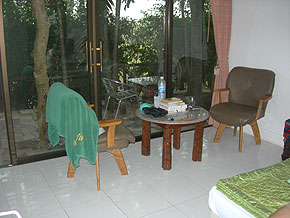
Room at Soi
Dao Garden Hotel
(Photo by Nick
Upton) |
|
| 
|
|
However,
a much more pleasant place to stay, if you have your own
transport, is to stay at the Soi Dao Garden Hotel (08 4945
3638), a few kilometres away, which has pleasant, air-conditioned
rooms with bathroom for 400 baht.
Their
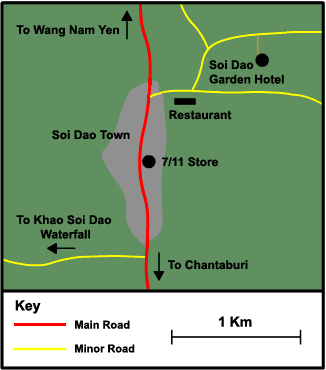
are signs for this hotel in Thai only but it is quite easy
to find. At the northernmost point of the small town of
Soi Dao there is a road which heads east. Take this road
and a few hundred metres along it the built-up area finishes
giving way to farmland. On the left is a small road with
a lightpost and some signs for the hotel (in Thai only).
Take this turning and continue up a short hill for another
300-400 metres and then a sign can be seen on the right,
at the entrance to a dirt track; this is the entrance to
the hotel. Drive along the dirt track for about 100 metres
and the hotel is obvious.
If you
cannot find this or it is full there are several other similar
places in the area including 2 along the access road to
Khao Soi Dao waterfall itself.
The
small town of Soi Dao has lots of street food at night and
a market during the day. Toasted sandwiches and coffee in
the 7/11 makes a reasonable breakfast for those maing an
early start.
|
|
|
|
| Some
Useful Books |
|
| Other
Related Pages |
Birdwatching
Tours/Guiding
Other
Southeastern Thailand Birding Locations |
| Photo
Galleries |
|
|
|
|
|
|
Birdwatching
Trips:
Khao Soi Dao does not fit in well with
long birdwatching itineraries due to its location, but
it is a great place for a few days and an expedition
up the mountain has the potential to find some seldom
seen species: Eastern Green Magpie, Black-browed Fulvetta,
Rufous-throated Fulvetta, Blue-rumped Pitta and Siamese
Partridge..
Take
a look at some suggested itineraries and contact me
for more information: Thailand
bird tours. |
|
|
| Trip
Reports |
|
| Related
Blog Entries |
| A
Strange Place to Nest - posted 04/08/08 |
| Donations |
If
you found this page useful, please consider making a donation.
|
| Tags |
| birds,
birding,
thailand,
nature, national
parks |